Saturday, October 25, 2008

U. mordax molt to 3I, new T. stigmurus

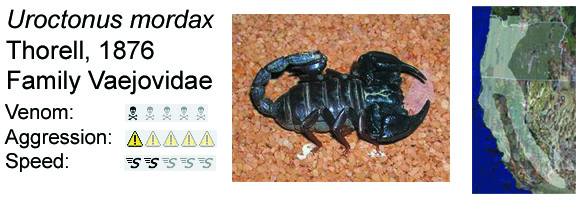
The first Uroctonus mordax from July's brood molted to third instar this week. The molt went from Monday night into Tuesday morning, and these photos were taken on Saturday. This is at an age of approximately three months.


Apparently one of the five I gave away molted the same night but didn't survive -- after speaking with the owner it seems conditions may have been too dry. Three of the five I gave away have now died; the other two I haven't heard about since passing them on to other hobbyists.

A couple of the others look almost ready to molt as well. One or two don't look anywhere near it and don't seem very interested in prey.

In other news, I recently got five third-instar Tityus stigmurus from a friend of mine in Texas. These guys are parthenogenetic and communal as adults, so I shouldn't have any problem getting a community up and running.


Wednesday, October 22, 2008

Community Ambitions

As stated before, I eventually want to have large display tanks for my communal species. Yesterday I was thinking of what sort of a goal I had in mind, and I came up with something along these lines:


The dimensions I came up with arbitrarily put the two left tanks at 6' x 2' -- if they have square cross-sections, then around 150 gallons!

Clockwise from upper left: H. longimanus, C. margaritatus, T. stigmurus, C. vittatus, H. judaicus, U. mordax, and P. imperator. The whole display would be about 12 feet long by 4 feet high. I'd have to spend a lot of money for a system where I could slide the tanks out to work on each one, especially because false bottoms will make the two on the left VERY heavy.

Each tank has a background photo from the country the species is native to (in the case of the US species, from a specific area they're found in).

Each will also be labeled:


Underneath the tanks would be a good place to keep feeders (cockroaches). I would probably also have a basic shelving system like I do now to keep the juveniles on (most of these species are communal only as adults).

I was discussing this with my fiancee -- to keep things even I'd want install a similar system for her tarantulas. :-D

Now we just have to get a house and I have to get a real job . . .

Tuesday, October 21, 2008

Miscellaneous Updates

I figure it's about time for a few random updates since I haven't posted in nearly a month, so here they are.

------

I've been trying to downsize my collection a bit, mainly so I could focus on keeping communal species -- I'd rather have a large pile of deli cups if I know that the inhabitants can eventually be housed together. My current collection (scorpions only) has been reduced to:

0.1.0 Centruroides hentzi
0.0.1 Centruroides margaritatus
0.1.0 Centruroides vittatus
0.0.2 Hadogenes paucidens
0.1.0 Hadrurus arizonensis
0.1.8 Heterometrus longimanus
0.0.5 Hottentotta judaicus
0.0.4 Pandinus imperator
0.5.0 Tityus stigmurus
1.4.12 Uroctonus mordax
0.0.1 Vaejovis spinigerus

The only species on that list that aren't communal are the H. paucidens, V. spinigerus, and H. arizonensis. I plan on passing those onto other hobbyists soon. The C. hentzi is an adult female that I've had for over a year so I'm not thinking of breeding her again -- I may just keep her til she expires rather than giving her to someone without knowing her age. The C. margaritatus I've decided to keep until adulthood in the hopes of finding a mate (this is the bicolor morph which is very pretty, and I would love to have a community of them).

------

Last week I was stopping by the lab I used to work in, and as luck would have it, the woman who spotted the U. mordax that birthed this summer found another one! On the floor of a classroom she was in, no less.

I have no idea how, but a third-instar U. mordax somehow made its way into one of the buildings at OSU. The habitat for this species has to be at least ten miles away. I asked an entomologist in the building if he knew anything about it, and the closest answer he could think of was an escapee from a soil litter sample somewhere in the building.

It sure worked out well for me, though!

------

The same day as the arrival of the renegade U. mordax, I got a package from a friend of mine in Texas -- five third-instar Tityus stigmurus. This is a beautiful orange and black species native to Brazil that happens to be parthenogenic (for those of you who don't know, that means it's capable of reproducing asexually; a mature female will simply give birth to little clones of herself). Hopefully this will be the easiest community I've ever attempted.

------

Last night I was checking on my second instar U. mordax and noticed one in kind of a funny pose. My thought, since it wasn't moving but clearly wasn't in the "dead" pose, was that it was preparing to molt. Later that night a friend of mine to whom I gave one of the other 2I said hers was molting -- after double-checking on mine, I saw the same thing!

None of my other nine from this brood have molted yet, so hopefully they will soon. Some look like they're still to skinny (I hope they begin to feed more). Oh, and I found out another one of the five that I gave away died.

------

A couple weekends ago I was checking on my U. mordax community and lifted a rock where there had previously been one adult and one subadult female -- now, there was one adult female and half of one subadult female.

I took the larger female out in case she may have been gravid (gravid females are known to be less communal across a lot of species). It was dissapointing to see my collection shrink, but as the saying goes, "all scorpions are communal until they aren't."

I thought it may have been due to the size discrepancy, but within a few days my male and the other subadult female had occupied the same hide under the rock. Also, I saw one in the corner when I went to mist, and discovered it was sitting on top of a tankmate. Perhaps I just had a grouchy female.

------

The same female mentioned in the above minipost was taken on a community outreach and gave me my first sting experience with this species. I was a little disappointed at how weak it was -- it barely went beyond "dry sting" status, and that's only because I felt a little tingling after the fact.

If you're wondering, I was attempting to scootch the female off of my hand and onto a student's at the outreach, and she flicked her tail back at me. I felt her stinger connect (like brushing your finger against a pin) but felt no pain -- just a slight tingling a minute later. I figure it was somethign akin to a scorpion "warning shot." I used it as a chance to explain to the students how harmless this species was even if it does decide to sting.

------

And finally, a non-scorpion post.

A friend of mine from Georgia was able to pick up a few brown widows the last time she visited home and told me she had a male if I was interested. I initially had two males; one got eaten by a female and one was more or less a runt that just died.

I picked up a male and female from my friend (they were cohabiting, so I figured that was a good sign) on Thursday night last week (I write this on Tuesday morning). Friday night I introduced him to my only female. There was much web-dancing and moving about the tank, as well as some movement by the female, but I eventually grew bored and left them alone. I returned later and saw the male in position, and could clearly see the reproductive structure unwound from his pedipalp and in the female's ventral opening (forgive my lack of knowledge with spider anatomy).

Shortly after I arrived they separated and the male backed off from the female -- I assumed I disturbed them and he would now be eaten. However, when I checked back in 12 hours, they were mating again! As of last night they were still successfully cohabiting.

I figure I can leave the male in there, as he's been with all the females in my posession and has no further use for me. If he gets eaten, that's too bad; if he stays alive, that's an good example countering the "widow" status of his partner (though she did eat the first male I offered her).

------

Hopefully soon I'll be able to post pictures of the new T. stigmurus as well as the freshly-molted U. mordax.

Friday, September 26, 2008

V. spinigerus stillborns

I've been waiting on one of my female Vaejovis spinigerus to birth since spring. This past Sunday (I write this on Friday, and the following pictures were taken on Thursday evening) I saw her in the "birth basket" stance, so I assumed she was going to give birth shortly. Then, nothing happened. Nothing happened for the next four days, either. Then on Thursday evening, I checked on her and saw she had a large white glob of something in one of her pinchers (she dropped it when I got the camera).


Yep, that's a cluster of stillborn scorpion embryos.


I have no idea how this happened or what caused it, but I have one thing to say about it:


I may email Kari McWest and see if he has anything to say on the matter.

Sunday, September 21, 2008

U. mordax Community

Yet another post about my favorite scorpion . . .

I finally reached one of my scorpion goals by setting up a community of this species: one male and five females collected in different areas of Oregon. The male and two of the females were those featured in this post, one female is the one featured in this post, one was the largest featured in this post, and the final female was collected in Eugene in 2007.

Here is the tank in its entirety:

Here's that stone on the right side at a different angle, to show one of the hides I provided:

I believe this is the female caught on Cougar Reservoir and the female that had a brood this summer:

And here is the male and one of the females caught on the same night:

The two others were hiding somewhere that I couldn't access as easily.

I believe the two most-recently caught females may be gravid, so I could have some more broods on my hands before long.

And just for fun, here's a map (looking east) of where these specimens came from:

Tuesday, September 16, 2008

Mordax not communal at 2I . . .

So I saw a couple more little corpses when I checked this morning (Sad), and decided to separate them this evening. I only found nine.

+ 26 in original brood
- 5 given to friends
- 4 unknown deaths (that number doesn't bother me so much)
- 9 recovered
------------------------
= 8 cannibalized

I guess that isn't too bad, but a 50/50 survival/cannibalism rate still kinda sucks. My H. longimanus only had 20% cannibalism.

So I think I'll be separating my next broods.

(I've been leaning towards specializing in this species and downsizing my collection a bit, so this is a handy piece of information to know for my two other gravid females.)

Tuesday, September 9, 2008

Successful U. mordax Hunt

(Pardon the photo quality in advance -- we were using my friend's point-and-shoot, which as I'm sure you know, wouldn't work too well in the dark.)

After one pathetic attempt (one female) and one completely fruitless attempt, I went back to Botkin Road with a friend of mine in the hopes of finding some U. mordax. It seems we did it right this time -- the right spot at night (as opposed to the wrong spot at night, or the right spot in the day).

The first spot we found anything at was on an exposed hill that would have been in the sun a few hours earlier. We found one female and one male underneath some pieces of plywood laying on the dirt.

BL pic of one of them:
The male:
They were found on the portion of the hill below the road -- looking above the road didn't turn anything up. We went up the road about another 1/4 mile to another exposed area. The soil on the hills here is really REALLY loose, and so we found nothing checking the second hill, either. We were about to give up when we blacklit under a rock that was laying on some more stable soil on the hill.

Two second instars! They were found within six inches of each other. I would have loved to get a pic of the both of them, but one ran away before we could get the camera. Here's a couple shots of the other one:

We let those two go. The guy I was with thought he heard something, so we did a sweep of the hill with our lights before heading back to his truck. I swept my blacklight across the hill and something green caught my eye. It was another female about ten feet from me! We scrambled up the hill and easily scooped her into the cup that we photographed the little one in and decided to call it a night.

A few pics from when we got back . . .

Tyler's first handling experience:

The male / female from underneath the plywood:
The second female: