Showing posts with label scorplings. Show all posts

Sunday, August 23, 2009

Daring First Instar

The first instar U. mordax that left mom's back early made it to 2I successfully. (S)he just took a day longer than the rest of the brood. I've named this one Dr. Livingstone.

I have a few pics of the molting, but the camera I was using just isn't up to the old DSLR's abilities. So here's a picture of one of the other broods molting to second instar. Some have molted, some haven't, and a couple are in the process of molting.

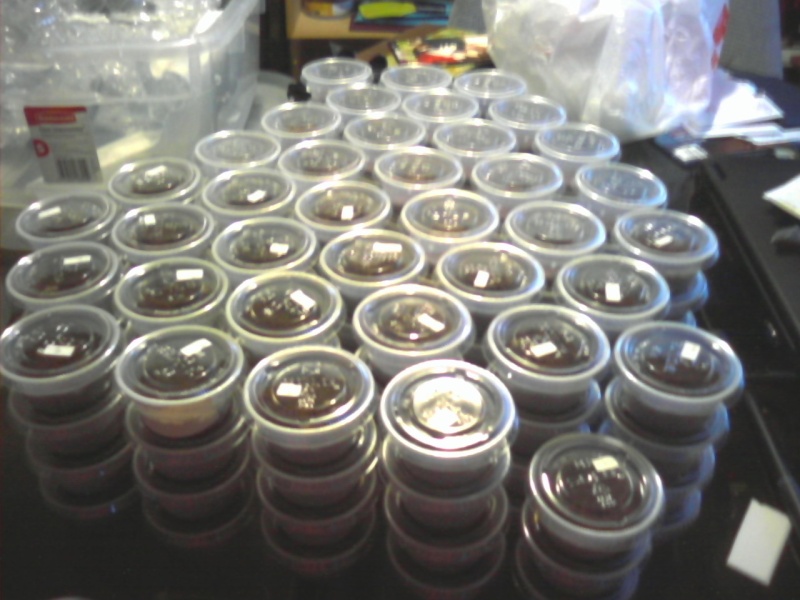
All Those Babies . . .

. . . sure take a long time to feed.


My original estimate of 160 was actually spot-on. 70 Vaejovis spinigerus and 90 Uroctonus mordax, although two U. mordax died shortly after molting to second instar. I've given a few away and I'm open to selling all of the V. spinigerus and up to half of the U. mordax, but no one's responded to my ads.

I'd like to track the growth and development of the ones I plan on keeping -- that's why some have labels indicating which female they came from.

I have two remaining U. mordax females that look suspiciously pudgy. Hmmm . . .

Wednesday, July 23, 2008

Uroctonus mordax to 2I

I've been checking on my Uroctonus mordax brood almost daily the past week, but I'd only been checking by holding a flashlight to the side of the container and looking underneath mom's hide from the edge of the tank. Each time I saw white, assumed nobody had molted, and put the light away until next time.

When I looked tonight, I thought I saw more definition to the scorplings than usual, so I risked removing the hide for some photography. And what do you know? They've begun molting to second instar!
Compared to my photo from last week, you can see that there's less "pudge," and they were also eager to scurry from mom's back at my disturbing them. In the next photo, you can see one of the molts on mom's carapace.


Either this species remains white at 2I, or I caught them recently enough that no one has had a chance to darken.

I'm thinking of removing mom from this container when the young scatter and trying a "juvenile community," to see if it's like emperor scorpions (juveniles do fine together) or bark scorpions (juveniles happily snack on each other). As these are forest scorpions, I'm hoping for the former, but I have heard of cannibalism in this species when different sizes were kept together.

Update from 7/26: More have molted and began to darken up.

Sunday, July 13, 2008

Uroctonus mordax Brood

While checking on and feeding my invertebrates today, I discovered I was correct when I thought my largest female Uroctonus mordax was gravid.

I counted at least 16 scorplings, with more possibly buried underneath. For those of you who aren't aware this species is native to the Pacific Northwest. This particular specimen was collected around 14 miles west of Corvallis, Oregon, in the Coast Range.

Here's a modified version of the above photo to better show the babies: