
Thursday, September 3, 2009
Centruroides sculpturatus Brood
A couple of weeks ago, I traded one of my two male C. sculpturatus for a gravid female. Yesterday, that trade paid off.


Sunday, August 23, 2009
New Emperor Arrives with Problems
There was a local show this weekend that a couple of invert-oriented friends were attending. When asked if I wanted anything, I requested a female Pandinus imperator if they could find one for less than $10. I have three subadult males (one of which is looking very close to molting) and wanted to try breeding this species. I'm probably the only person in this hobby who's first emperor DIDN'T arrive already gravid.
I think sending my friends good sexing photos paid off, because they brought me this huge $7 beauty.

She was moving around too much to get a good measurement, but I estimate her to be between five and six inches (chelicerae to telson). Watching her "glass-dance," I was able to tell that she's definitely a female.

Now, for those of you experienced in this hobby: do you notice anything unusual about the next photo?

Yep, she's got grain mites. This is actually the first time I've encountered them personally. The usual advice is to put the scorpion in a dry ICU tank (with a water dish, at least) to dehydrate and kill the mites. The other advice is to find predatory mites from other tanks to feed on the grain mites.
I'm sticking to the latter method, because the LAST thing I want is for a forest scorpion to give birth in a dry environment. Odds are in favor of this female being gravid. So, for the time being, I've added as many predatory mites as I could find in my other tanks and I'm keeping her quarantined. Hopefully it pays off.
I think sending my friends good sexing photos paid off, because they brought me this huge $7 beauty.

She was moving around too much to get a good measurement, but I estimate her to be between five and six inches (chelicerae to telson). Watching her "glass-dance," I was able to tell that she's definitely a female.

Now, for those of you experienced in this hobby: do you notice anything unusual about the next photo?

Yep, she's got grain mites. This is actually the first time I've encountered them personally. The usual advice is to put the scorpion in a dry ICU tank (with a water dish, at least) to dehydrate and kill the mites. The other advice is to find predatory mites from other tanks to feed on the grain mites.
I'm sticking to the latter method, because the LAST thing I want is for a forest scorpion to give birth in a dry environment. Odds are in favor of this female being gravid. So, for the time being, I've added as many predatory mites as I could find in my other tanks and I'm keeping her quarantined. Hopefully it pays off.
Daring First Instar
The first instar U. mordax that left mom's back early made it to 2I successfully. (S)he just took a day longer than the rest of the brood. I've named this one Dr. Livingstone.
I have a few pics of the molting, but the camera I was using just isn't up to the old DSLR's abilities. So here's a picture of one of the other broods molting to second instar. Some have molted, some haven't, and a couple are in the process of molting.

I have a few pics of the molting, but the camera I was using just isn't up to the old DSLR's abilities. So here's a picture of one of the other broods molting to second instar. Some have molted, some haven't, and a couple are in the process of molting.

All Those Babies . . .
. . . sure take a long time to feed.

My original estimate of 160 was actually spot-on. 70 Vaejovis spinigerus and 90 Uroctonus mordax, although two U. mordax died shortly after molting to second instar. I've given a few away and I'm open to selling all of the V. spinigerus and up to half of the U. mordax, but no one's responded to my ads.
I'd like to track the growth and development of the ones I plan on keeping -- that's why some have labels indicating which female they came from.
I have two remaining U. mordax females that look suspiciously pudgy. Hmmm . . .
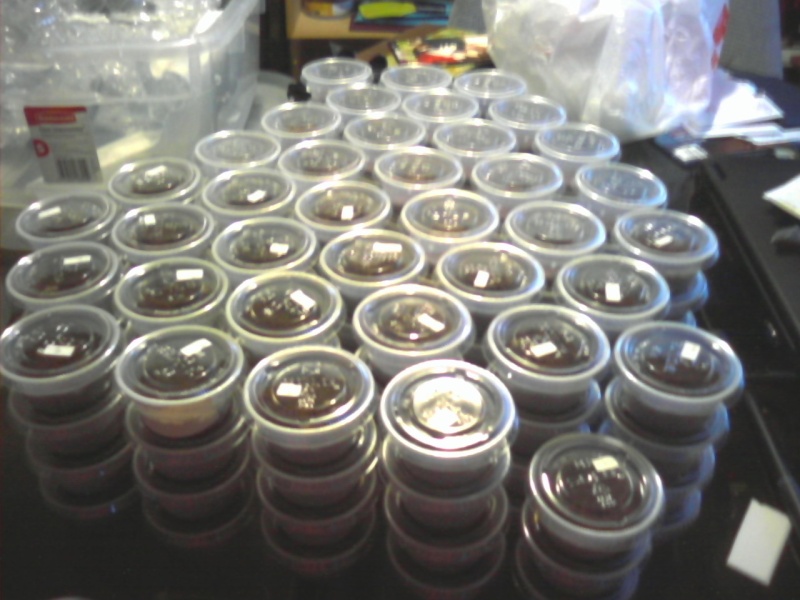
My original estimate of 160 was actually spot-on. 70 Vaejovis spinigerus and 90 Uroctonus mordax, although two U. mordax died shortly after molting to second instar. I've given a few away and I'm open to selling all of the V. spinigerus and up to half of the U. mordax, but no one's responded to my ads.
I'd like to track the growth and development of the ones I plan on keeping -- that's why some have labels indicating which female they came from.
I have two remaining U. mordax females that look suspiciously pudgy. Hmmm . . .
Tuesday, July 21, 2009
Myriad of Births
"Update more frequently" . . . HA! Well, at least my dad gave my fiancee his decent point-and-shoot, so I no longer have an excuse to not take pictures.
My former professor returned from Arizona with a handful of Vaejovis spp., the largest of which appeared to be a heavily gravid V. spinigerus (or Hoffimanus spinigerus, if you're in the Soleglad and Fett camp). More on her later.
Two weekends ago I was preparing to leave for a family reunion. Friday afternoon I checked on one of my U. mordax females (collected May 1 with professor et al) to show a visiting guest, only to discover she had given birth. Returning home on Sunday evening revealed two more from the same trip had followed suit. By Friday, all four collected May 1 were carrying broods. A quick check also revealed that the large Vaejovis from Arizona also had a pile of young on her back.
Based on the one brood I experienced last summer, I estimated that the first of this year's would molt to second instar on Monday (yesterday). I surprised myself by being correct.
First brood discovered:

Molting to second-instar yesterday morning:
Second brood discovered:

The general consensus is that first instars are doomed without mom. This little guy from brood #2 decided to prove that wrong. He's still fine after having been away from the burrow for four days.

Third brood discovered (this female sealed herself in and burrowed to the bottom of the tank -- fortunately she cleared out an area against the bottom so I could photograph her):

Fourth brood discovered:

And the Vaejovis -- this species is known for having broods of 60 or more young.

In addition to all of these, I have three more female U. mordax. Two of these look like they may be gravid. One spent all winter with a male (recently died, assumed to have been old age) and one was collected at the end of last summer from Detroit. I'm fairly sure that populations from the Cascade Mountains give birth later in the year than those collected in the Coast Range, so we'll have to wait and see what she does.
I also have a friend whom I gave a female on another collecting trip in May. He told me she's looking fatter, and I suspect he'll give me any offspring rather than deal with them himself. Current estimate of young in my possession is 160; if I get young from the other females, my estimate would rise to 235.
My former professor returned from Arizona with a handful of Vaejovis spp., the largest of which appeared to be a heavily gravid V. spinigerus (or Hoffimanus spinigerus, if you're in the Soleglad and Fett camp). More on her later.
Two weekends ago I was preparing to leave for a family reunion. Friday afternoon I checked on one of my U. mordax females (collected May 1 with professor et al) to show a visiting guest, only to discover she had given birth. Returning home on Sunday evening revealed two more from the same trip had followed suit. By Friday, all four collected May 1 were carrying broods. A quick check also revealed that the large Vaejovis from Arizona also had a pile of young on her back.
Based on the one brood I experienced last summer, I estimated that the first of this year's would molt to second instar on Monday (yesterday). I surprised myself by being correct.
First brood discovered:

Molting to second-instar yesterday morning:
Second brood discovered:

The general consensus is that first instars are doomed without mom. This little guy from brood #2 decided to prove that wrong. He's still fine after having been away from the burrow for four days.

Third brood discovered (this female sealed herself in and burrowed to the bottom of the tank -- fortunately she cleared out an area against the bottom so I could photograph her):

Fourth brood discovered:

And the Vaejovis -- this species is known for having broods of 60 or more young.

In addition to all of these, I have three more female U. mordax. Two of these look like they may be gravid. One spent all winter with a male (recently died, assumed to have been old age) and one was collected at the end of last summer from Detroit. I'm fairly sure that populations from the Cascade Mountains give birth later in the year than those collected in the Coast Range, so we'll have to wait and see what she does.
I also have a friend whom I gave a female on another collecting trip in May. He told me she's looking fatter, and I suspect he'll give me any offspring rather than deal with them himself. Current estimate of young in my possession is 160; if I get young from the other females, my estimate would rise to 235.
Saturday, June 6, 2009
Mordax Hunt and Miscellaneous Updates
Part of the reason I've been updating so infrequently (aside from losing the household's good camera) was because the end of my senior year at OSU was rearing its ugly head -- but classes are over, and I graduate a week from today, so I hope to update more frequently. I also plan on getting the camera fixed (or buying a new one) once I put my degree to use for employment . . . though that may be a while.
Mordax Hunt
The second annual BugZoo camping trip was last weekend. Last year I found the scorpions featured in this post, and as we booked the same campground, I hoped to catch a few more this year. I had also been contacted by a researcher in the Midwest interested in doing a developmental study on this species who had requested that I collect a few gravid females for him.
The first night of blacklighting was at the same spot we found the specimens last year, and like last year, we didn't find much. Just five small juveniles. Coming back a second night, we looked a little farther along the road, where it was more of a cliff face than a talus slope, and we hit the jackpot! Fourteen specimens, including the four females I needed. The majority were hiding in cracks and crevices along the cliff face -- a few got away because they disappeared into cracks between huge pieces of rock that we couldn't possibly move. We probably saw at least twenty that night.
The count for the whole trip: five adult females (four gravid), five adult males, five immature females, five immature males. Another BugZoo member who provided the blacklight kept the non-gravid adult female (who stung him when he collected her, so we figured they were meant to be), two of the adult males, and three of the immatures. I sent the four gravid females to the researcher and gave the BugZoo a male and female subadult pair. I kept the remainder for my personal collection. It's nice to have a few more males, as I only had one prior to this.
(On a side-note, if anyone reading this is concerned about over-collecting: as I mentioned, there were a number that got away before we had a chance to collect them, and there were likely many more hiding beneath rocks that we never even saw -- our collecting was only by sweeping the blacklight around the area and overturning only a handful of the hundreds of rocks beside the road.)
Miscellaneous Updates
A friend of my fiancee's who lives near Phoenix routinely finds Arizona bark scorpions (Centruroides sculpturatus) in and around her home. She was gracious enough to agree to ship them to me after I sent her a box full of vials and some shipping funds. To date, she has sent me two males of the aforementioned species, one Vaejovis spinigerus, and one Hadrurus arizonensis (missing the movable finger of one chela, which makes for interesting feeding observations). I'm hoping she finds a female bark scorpion; I'd love to have a little community of these guys.
On the bark scorpion note, the professor who accompanied me on a mordax hunt last month is going to be visiting Arizona later this month and has offered to collect some scorpions for me. He seems genuinely excited about the prospect, especially after seeing the H. arizonensis I recieved.
My Centruroides vittatus seems to have reabsorbed the embryos again. I think I should just keep my eyes peeled for a cheap male.
I fed the majority of my scorpions last night. My Tityus stigmurus readily accepted prey, which was somewhat of a relief, because none have molted in several months and didn't seem to be growing much. They often panic when offered prey. My cave spider (Damon sp.) also ate a large cockroach -- she always worries me because she waits until I'm not looking before eating, so I never know if she eats. It doesn't help that she's such a skinny species.
The Antrodiaetus pacificus I found in April has excavated a sizeable burrow in her container -- it runs along the bottom so I can see her hiding out quite well. No eggsac as of yet.
Mordax Hunt
The second annual BugZoo camping trip was last weekend. Last year I found the scorpions featured in this post, and as we booked the same campground, I hoped to catch a few more this year. I had also been contacted by a researcher in the Midwest interested in doing a developmental study on this species who had requested that I collect a few gravid females for him.
The first night of blacklighting was at the same spot we found the specimens last year, and like last year, we didn't find much. Just five small juveniles. Coming back a second night, we looked a little farther along the road, where it was more of a cliff face than a talus slope, and we hit the jackpot! Fourteen specimens, including the four females I needed. The majority were hiding in cracks and crevices along the cliff face -- a few got away because they disappeared into cracks between huge pieces of rock that we couldn't possibly move. We probably saw at least twenty that night.
The count for the whole trip: five adult females (four gravid), five adult males, five immature females, five immature males. Another BugZoo member who provided the blacklight kept the non-gravid adult female (who stung him when he collected her, so we figured they were meant to be), two of the adult males, and three of the immatures. I sent the four gravid females to the researcher and gave the BugZoo a male and female subadult pair. I kept the remainder for my personal collection. It's nice to have a few more males, as I only had one prior to this.
(On a side-note, if anyone reading this is concerned about over-collecting: as I mentioned, there were a number that got away before we had a chance to collect them, and there were likely many more hiding beneath rocks that we never even saw -- our collecting was only by sweeping the blacklight around the area and overturning only a handful of the hundreds of rocks beside the road.)
Miscellaneous Updates
A friend of my fiancee's who lives near Phoenix routinely finds Arizona bark scorpions (Centruroides sculpturatus) in and around her home. She was gracious enough to agree to ship them to me after I sent her a box full of vials and some shipping funds. To date, she has sent me two males of the aforementioned species, one Vaejovis spinigerus, and one Hadrurus arizonensis (missing the movable finger of one chela, which makes for interesting feeding observations). I'm hoping she finds a female bark scorpion; I'd love to have a little community of these guys.
On the bark scorpion note, the professor who accompanied me on a mordax hunt last month is going to be visiting Arizona later this month and has offered to collect some scorpions for me. He seems genuinely excited about the prospect, especially after seeing the H. arizonensis I recieved.
My Centruroides vittatus seems to have reabsorbed the embryos again. I think I should just keep my eyes peeled for a cheap male.
I fed the majority of my scorpions last night. My Tityus stigmurus readily accepted prey, which was somewhat of a relief, because none have molted in several months and didn't seem to be growing much. They often panic when offered prey. My cave spider (Damon sp.) also ate a large cockroach -- she always worries me because she waits until I'm not looking before eating, so I never know if she eats. It doesn't help that she's such a skinny species.
The Antrodiaetus pacificus I found in April has excavated a sizeable burrow in her container -- it runs along the bottom so I can see her hiding out quite well. No eggsac as of yet.
Saturday, May 2, 2009
Another Uroctonus mordax Hunt
After showing a professor of mine a U. mordax and letting him hold it, he got excited enough to want to go catch some. On top of that, his youngest daughter is a budding bugoholic and also got excited at the prospect of finding scorpions. So, tonight we headed off to my favorite scorpion-hunting site in Oregon -- myself, my professor, his wife, and their three kids.
I directed them to a pile of old plywood that I'd found a male / female pair under the previous fall. While chatting about how to find them, lifting up the second piece of plywood yielded our first specimen: an adult female. I couldn't believe how excited everyone was, but it's always fun the first time you see a scorpion just sitting out there in the wild, glowing under your blacklight. I handed off the BL to my prof. and moved the scorpion to a vial.
In the same pile of plywood, a few minutes later, we turned up another female. Everyone was understandably excited, finding two so close together. We had now tied this pile's yield compared to prior expeditions.
Nearly finished with this pile, we flipped over one long piece to discover not one, but TWO females hiding beneath! After much shuffling of vials, we caught both of them, only to discover another female hanging out between the two others. The count so far: five adult females, one for each vial I'd brought.
The pile was exhausted so we headed up the hill to check a couple other spots I'd found scorpions at before. We packed a few napkins around those we'd already collected in case we had to double up on vials. After much rock-flipping and log-turning I eventually located a feisty juvenile under a piece of bark on the side of a hill. My professor's daughters thought it was cute for being so much smaller.
Climbing back down a hill a few minutes later I happened to sweep my light in the path I was about to step and found ANOTHER, out in the open! This one was a little smaller, possibly a subadult. My prof's family had already headed back to the truck with the vials, so he held onto her while we walked down. As luck would have it, randomly sweeping my light across the hill beside the road as I walked by revealed a glint of bright green. Yet another scorpion, this time a male hanging out in his burrow. I kept watch as I waited for someone to return with a vial.
Before tonight, the total number of scorpions I'd found here was six. Tonight's collection alone totaled EIGHT!
Final count: five adult females (all of them fat enough to suggest they're gravid), one adult male, one unsexed juvenile, and one male subadult.
One adult female and the male went to my prof's daughter to keep. If his other daughters still want one after the novelty wears off, they might get another one or two.
Pics up soon, hopefully.
Edit: Here be the pics!
Definitely time to get the DSLR fixed.
The four females I kept, along with the baby male:

The subadult male . . . he's got a real attitude!


Three of the ladies. You can see that they're pretty fat in this pic.

And a shot of "junior."

I directed them to a pile of old plywood that I'd found a male / female pair under the previous fall. While chatting about how to find them, lifting up the second piece of plywood yielded our first specimen: an adult female. I couldn't believe how excited everyone was, but it's always fun the first time you see a scorpion just sitting out there in the wild, glowing under your blacklight. I handed off the BL to my prof. and moved the scorpion to a vial.
In the same pile of plywood, a few minutes later, we turned up another female. Everyone was understandably excited, finding two so close together. We had now tied this pile's yield compared to prior expeditions.
Nearly finished with this pile, we flipped over one long piece to discover not one, but TWO females hiding beneath! After much shuffling of vials, we caught both of them, only to discover another female hanging out between the two others. The count so far: five adult females, one for each vial I'd brought.
The pile was exhausted so we headed up the hill to check a couple other spots I'd found scorpions at before. We packed a few napkins around those we'd already collected in case we had to double up on vials. After much rock-flipping and log-turning I eventually located a feisty juvenile under a piece of bark on the side of a hill. My professor's daughters thought it was cute for being so much smaller.
Climbing back down a hill a few minutes later I happened to sweep my light in the path I was about to step and found ANOTHER, out in the open! This one was a little smaller, possibly a subadult. My prof's family had already headed back to the truck with the vials, so he held onto her while we walked down. As luck would have it, randomly sweeping my light across the hill beside the road as I walked by revealed a glint of bright green. Yet another scorpion, this time a male hanging out in his burrow. I kept watch as I waited for someone to return with a vial.
Before tonight, the total number of scorpions I'd found here was six. Tonight's collection alone totaled EIGHT!
Final count: five adult females (all of them fat enough to suggest they're gravid), one adult male, one unsexed juvenile, and one male subadult.
One adult female and the male went to my prof's daughter to keep. If his other daughters still want one after the novelty wears off, they might get another one or two.
Pics up soon, hopefully.
Edit: Here be the pics!
Definitely time to get the DSLR fixed.
The four females I kept, along with the baby male:
The subadult male . . . he's got a real attitude!
Three of the ladies. You can see that they're pretty fat in this pic.
And a shot of "junior."
Subscribe to:
Posts (Atom)


 Posts
Posts


